Serving Jurupa Valley, CA and surrounding areas.(951) 555-0159
SkyVale Jurupa Valley Concrete

Concrete Steps Construction in Jurupa Valley, CA, From the Parking Pad to a Raised House

SkyVale Jurupa Valley Concrete divides the rise before a trench is opened, holds every riser inside 3/8 inch of the next and foots both ends below the old fill. Every estimate is measured and written on site.

Google reviewsFacebook reviewsBetter Business Bureau reviews5.0 Stars Rated by our customers · Google, Facebook and the BBB
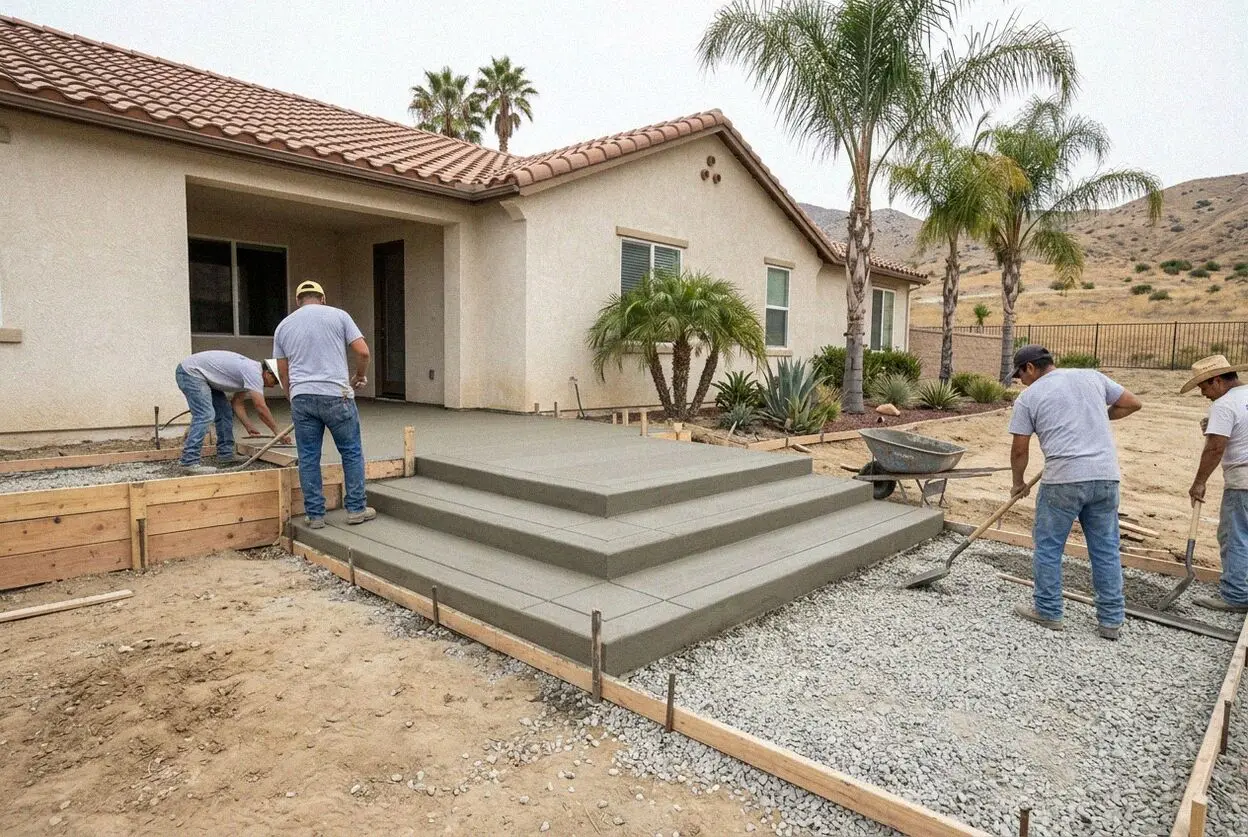
A new concrete step flight climbing to a raised house pad in Jurupa Valley, CA
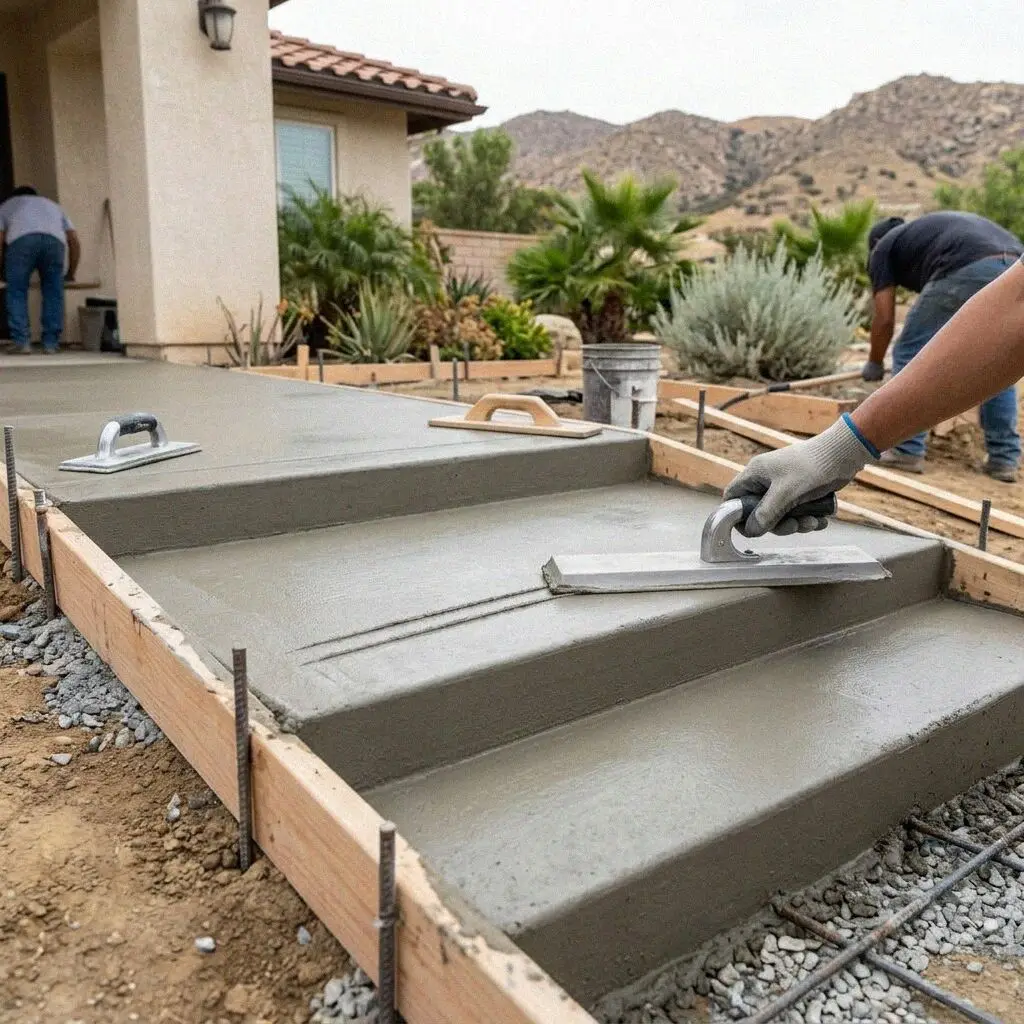
Crew forming the risers of a new step flight in Jurupa Valley, CA

Where the rise comes from

How a Jurupa Valley Flight Is Divided Before It Is Dug

On a lot out here both ends of a stair are already fixed. The house sits on a pad graded to its own level and the cars sit on another, and neither one shifts to suit a set of steps. The only thing left to decide is how many risers go between them. Read the total height, divide it into a whole number of equal steps with none over 7 3/4 inches, and a foot climbs it in the dark without looking. Get the count wrong and the leftover lands in one step, which is the one somebody trips on.

SkyVale Jurupa Valley Concrete was founded in 2025 by Daniel Reyes, who spent 12 years on Inland Empire flatwork crews first, and he reads the height on every flight himself. Two jobs fill the diary here. One is a couple of entry steps at a house older than the city, cast straight onto graded soil. The other is a climb of five or six from a parking pad up to a house pad benched into the slope.

A CSLB C-8 concrete license and liability insurance on every job sit behind the work, and the riser, tread, landing and handrail figures come out of the California Residential Code, the volume written for a one- or two-family house. A house answers to that code, not to the tighter stair rules written for commercial buildings. Anything that moves a landing height is filed at the Building and Safety Department, issuing this city's own permits only since 2011.


When patching is finished

What says a Jurupa Valley flight has to come out?

No concrete under the flight

Put a trowel in beside the lowest riser and see if concrete carries on down. Entry steps at houses built while this was county land went straight onto graded soil, so the flight rides the seasons while the house stands still. The line at the wall opens a fraction more each winter.

A short step at the bottom

A driveway repoured over the old one lifts the ground the flight lands on, and the bottom riser loses whatever the new slab added. You find it at the end of the way down, where the last lift is the one nobody looks at. Nothing laid on a tread hands that height back.

A crack across the top tread

A line running the width of a tread, at the back where it meets the riser above, says the flight is spanning ground that has dropped away underneath it. On a pad benched into a slope the made half goes on settling for years after the cut was made. Grouting it only hides where it is.

Six steps and nothing to grip

Count the risers on the climb up from the pad. From four upward the code wants a rail the length of the flight, and plenty of these were built before anyone asked for one. In the wet people come down them at an angle, or grab a fence post bedded in nothing but soil.

In on every flight

Every Jurupa Valley Flight We Cast Includes

Every line below is in the price of the flight, never offered afterwards as an upgrade. Each answers a condition a property here puts on steps: two pads graded to different levels, soft ground under the lowest riser, or a climb long enough to want a rail.

Height shot off a laser

Pad to threshold is shot with a level, divided into a whole number of equal risers and counted before a figure is written.

Footings at both ends

Both ends stand on footings dug for them, taken past the graded fill until a probe will not push any further down.

Risers held to 3/8 inch

Every form is marked from a single story pole, which keeps the flight inside 3/8 inch top to bottom and no riser over 7 3/4 inches.

A tread run of 11 inches

Each tread gives 11 inches of run where the code asks 10, and its nosing laps the riser beneath so nothing but heel hangs off.

Number 4 bar in the risers

Bar runs the width of every riser and turns down into the footing, so the flight and what carries it work as one piece.

A landing 36 inches deep

A landing of 36 inches or more, as wide as the steps themselves, so nobody backs down a riser to get a screen door open.

Rail anchors cast in wet

Where the count reaches four, anchors are pushed into wet concrete so the finished grip lands between 34 and 38 inches.

Filed at the city counter

Lodged with Building and Safety on Limonite Avenue where the work needs it, the inspection met at the forms, and the paperwork closed out.

The four options

Jurupa Valley Step Options, Set Side by Side

Four answers to a climb that has failed, weighed on what carries the steps, where each one belongs, what it costs you in upkeep and how many years it gives back. Two of them can re-divide the height; the other two take on whatever is already there.

OptionHeld up byBelongs onWants laterLasts
Poured on site in one goTwo footings cut below fillAny climb, height re-dividedA seal coat every 5 yearsPast 40 years
Poured core, brick facedThe same footings under the coreA ranch house already faced in brickJoints repointed at 8 yearsCore 40 years, face 20
Precast units set downA bedded pad and nothing deeperA single step at a shop doorReset it whenever it rocks20 years, less on fill
Overlay on the old flightNothing new, the old bearingEven risers and no crackingSealed again every 2 years5 to 8 years

Only the two poured options can change a riser height. A brick face is the most upkeep of the four, and it earns that on a house already wearing brick.

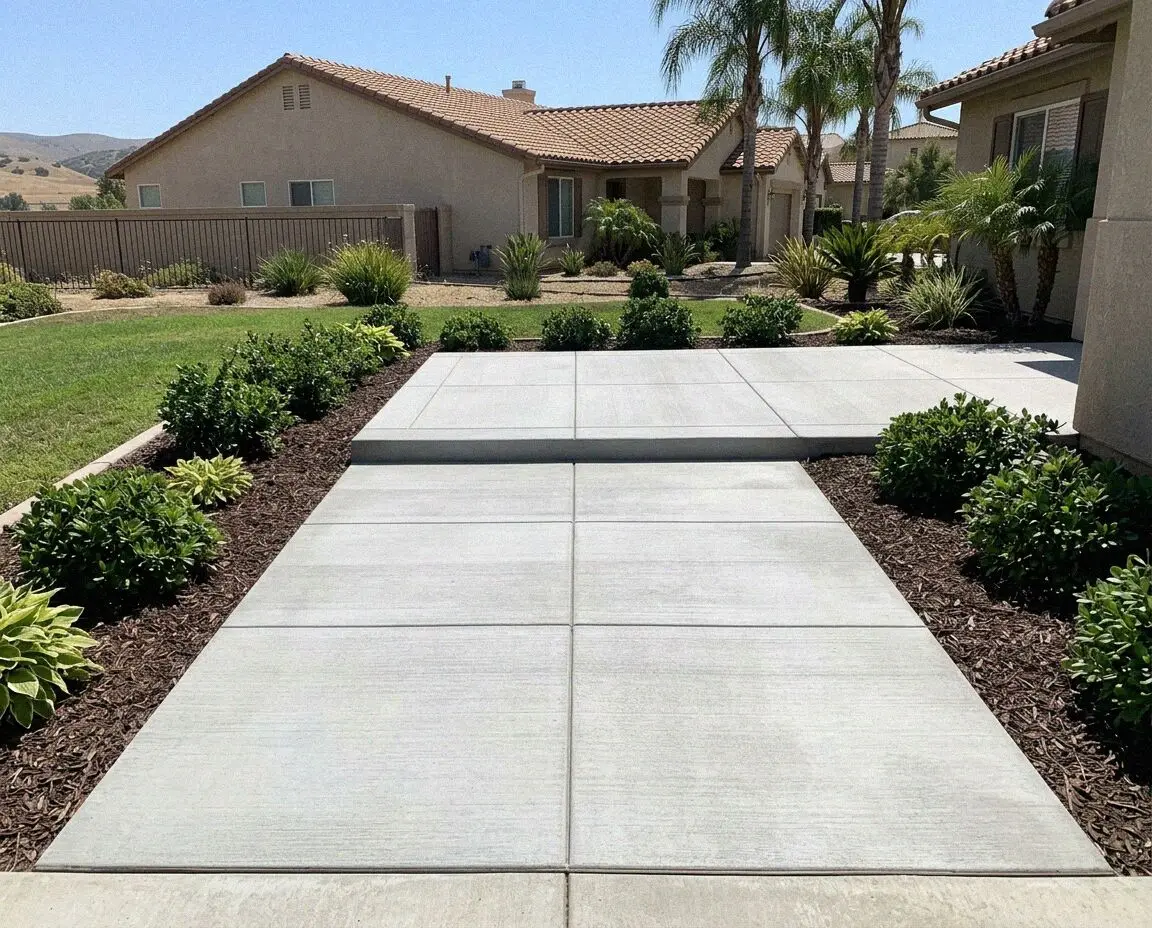
Concrete steps rising from a driveway to a raised house in Jurupa Valley, CA

Two grounds, one city

Why the Ground Decides a Climb on This Side of the River

A stair loads a strip of ground a foot wide with the weight of the whole climb, so what is under the lowest riser matters here more than anywhere else on the property.

Down on the flats the trench finds Santa Ana River sand with rounded stone through it, which carries a footing well once it is reached but runs out from under an edge that stopped short. Climb toward the Jurupa Hills and the trench is in decomposed granite, firm while dry and slurry once soaked, so a footing is cut into it rather than stood on the ravelled face. One sloping lot hands over both, which is why each end is probed rather than assumed from the other.

The second half is the age of the house. Jurupa Valley was made a city in 2011 out of nine county communities, Rubidoux, Pedley, Glen Avon, Mira Loma and Sunnyslope among them, and the entries at those addresses were built as county work with no footing beneath them at all. Where the driveway climbs and the flight cuts through the bank beside it, the bank is held by a retaining wall built on the same visit, so nothing ends up leaning on a raw cut face.

Level to handrail

How a Step Job Runs From Level to Handrail

Five stages, from the first level reading to the day the rail is bolted down. One crew does all of it, and whatever the counter needs is lodged while the old steps are still standing.

1

The climb measured

Daniel Reyes takes the level from pad to threshold, works out how many equal risers fit, checks the landing and writes the figure there.

2

Sketch to the counter

A sketch carrying the heights, the run, the landing and the rail goes to Building and Safety on Limonite Avenue where the job calls for one.

3

Old flight out, trenches in

Everything comes out and goes on the truck the same day, then a trench at each end is cut down until a probe meets real resistance.

4

Formed, tied and placed

Risers formed to the pole marks, bar tied and hooked into both footings, then the whole climb placed off one load and broomed.

5

Stripped, railed, handed over

With the forms off the heights are read against the sketch, the rail is bolted to its anchors and Daniel Reyes walks the climb with you.

What moves the figure

What Moves the Figure on a Step Job Here?

Start with the height, because the riser count follows from it and so does how much yard the flight eats on its way down. Everything after that comes out of what the two trenches turn up when they are opened.

The height of the climb

A yard of height comes out at five risers and four feet at six, and every riser added is more forming and more rail to fit.

What the probe hits

Fill on an older lot can stay soft well down and the trench has to chase it. That is concrete that ends up under the ground.

Rail, guard or the pair

Four risers brings the rail in. A landing standing more than 30 inches over the ground at its side brings a guard in with it.

A face over the concrete

Brick or stone set over the poured core brings a second trade onto one flight and holds first use back by three days.

Nothing is asked for the visit or the written figure, and somebody rings you back within 1 business day to put days against the work. (951) 555-0159 or send us a message.

Time to rebuild the climb to your door?

Ring the Limonite Avenue yard or fill in the form. Daniel Reyes drives out, puts a level on the climb, works out how the height splits and writes the whole job down at your door before he leaves. Nothing is owed for that visit.

Request a Free Estimate

Written on site · No obligation

By submitting, you agree to our disclosure and consent terms, including being contacted by SkyVale Jurupa Valley Concrete.

Three local climbs

What Owners Here Say About Their New Climbs

Three reviews posted after the rail went up. None of them is about a drive or a slab: all three are steps, and all three talk about how the climb feels rather than how it looks from the road.

Google review

“The pair of steps at our front door went in during the seventies, straight onto dirt, and they had leaned away from the house. Both ends got a real footing this time and the finish was matched to the walk. That finger-wide gap has stayed shut.”

T. Whitcombe, RubidouxEntry steps recast on footings · Google · 2026
Google review

“Our house sits well above where we park and the old climb had one riser taller than the rest. They marked the forms off one pole and dropped the anchors in before the concrete stiffened, so nothing had to be drilled afterwards. Six steps that all feel alike is the whole thing.”

L. Ontiveros, PedleySix-riser climb and rail · Google · 2026
Facebook review

“We had the driveway raised years ago and it left the bottom step about two inches shallower than the others. Daniel worked out the whole rise again and brought the flight one riser further out onto the concrete. My mother uses it now without holding anything.”

A. Basara, Mira LomaFlight re-divided and rebuilt · Facebook · 2025

Common questions

Questions Asked Here Before a Flight Is Booked

The heights the code fixes, what a trench has to reach before a footing is poured, and how many days a crew spends between your parking pad and your front door.

(951) 555-0159
  • What decides the cost of building a new flight?

    Height, first and by a long way: it fixes the riser count, and the riser count fixes how much forming there is. Next is how deep the trenches go before they reach something solid, and last is whether a rail, a guard or a brick face belongs on it. Every estimate is measured and written on site, which is why no figure leaves here off the back of a photo.

  • What is the maximum riser height on a home stair?

    The ceiling is 7 3/4 inches of riser, and the tread under it has to run 10 inches or more. Both numbers belong to the California Residential Code, the part of it written for a one- or two-family house. What really decides how a climb reads underfoot is the 3/8 inch tolerance across the whole flight, since a foot simply repeats the lift it made on the step before.

  • When do a set of steps have to have a handrail?

    At four risers. Above that count the climb needs a rail a hand can close around, unbroken from bottom to top, its grip set 34 to 38 inches over the nosings. The guard is a separate rule. Where a landing or a tread stands over 30 inches above the ground at its side, ordinary enough on the benched pads below the Jurupa Hills, that open side is guarded too.

  • Does the city need to see a step job here?

    If the new flight sits where the old one did and tops out at the same height, usually not. Move a landing height, add a guard or touch anything structural on the house and it does, and that goes to the Building and Safety Department. Older entries were signed off by Riverside County before 2011, so the file on those sits at the county rather than the city. The filing and the inspection are ours to handle.

  • Is resurfacing an option instead of a rebuild?

    Only on a flight that is sound and already even, since a topping takes on the shape of whatever is beneath it instead of putting it right. A quarter inch of it on each tread also steals that much from the top step, because the threshold above has not moved. A riser more than 3/8 inch out, or a tread cracked right across, puts the job back to a rebuild.

  • How soon can a new flight be walked on and used?

    Nobody walks on it for 24 hours and nothing heavy goes down it for 7 days, the point at which a 3,500 psi mix has made the strength it was ordered at. The rail goes on the morning after the pour, once the concrete will hold an anchor. If the climb is the only way in, it is poured in two halves so one side stays usable, and that is decided at the measurement.

  • What mix and what steel go into one of these flights?

    3,500 psi ready-mix batched at a plant in the county, with number 4 bar running through the risers and hooked down into footings that sit on undisturbed ground. Every tread is broomed at right angles to the way down and its front edge tooled off. Facing a flight in brick changes nothing underneath it; the brick is bedded once the core has had its week.

  • What if a new flight settles or cracks later on?

    You are handed a written workmanship guarantee against defects in how it was built when we walk the finished climb. What it covers is the depth we dug to, the heights we set, the landing, the anchors and the finish, all of it buried or bolted down by the time the forms come off. It does not cover harm done afterwards, whether that is a vehicle backing in or a burst sprinkler line hollowing out a footing.

Where we build steps

Steps and Entry Climbs Beyond Jurupa Valley

Every town on the list, ordered by how far it sits from the yard on Limonite Avenue. A climb up to a raised pad is booked the same way in all of them.

Show All Areas We Serve

Put Your Steps in the Diary This Week

Send the form or ring the yard, and Daniel Reyes calls you back within 1 business day. Tell us what the climb looks like now, the rough number of steps and whether anything is there to hold, and a slot inside the same week is usually free.