Serving Jurupa Valley, CA and surrounding areas.(951) 555-0159
SkyVale Jurupa Valley Concrete

Stamped Concrete in Jurupa Valley, CA, Patterned at the Scale of the Lot

SkyVale Jurupa Valley Concrete draws the joint grid to the area before a mat is picked, so the saw cuts land on grout lines instead of across the stones. Pattern, color and cuts all go on the estimate.

Google reviewsFacebook reviewsBetter Business Bureau reviews5.0 Stars Rated by our customers · Google, Facebook and the BBB
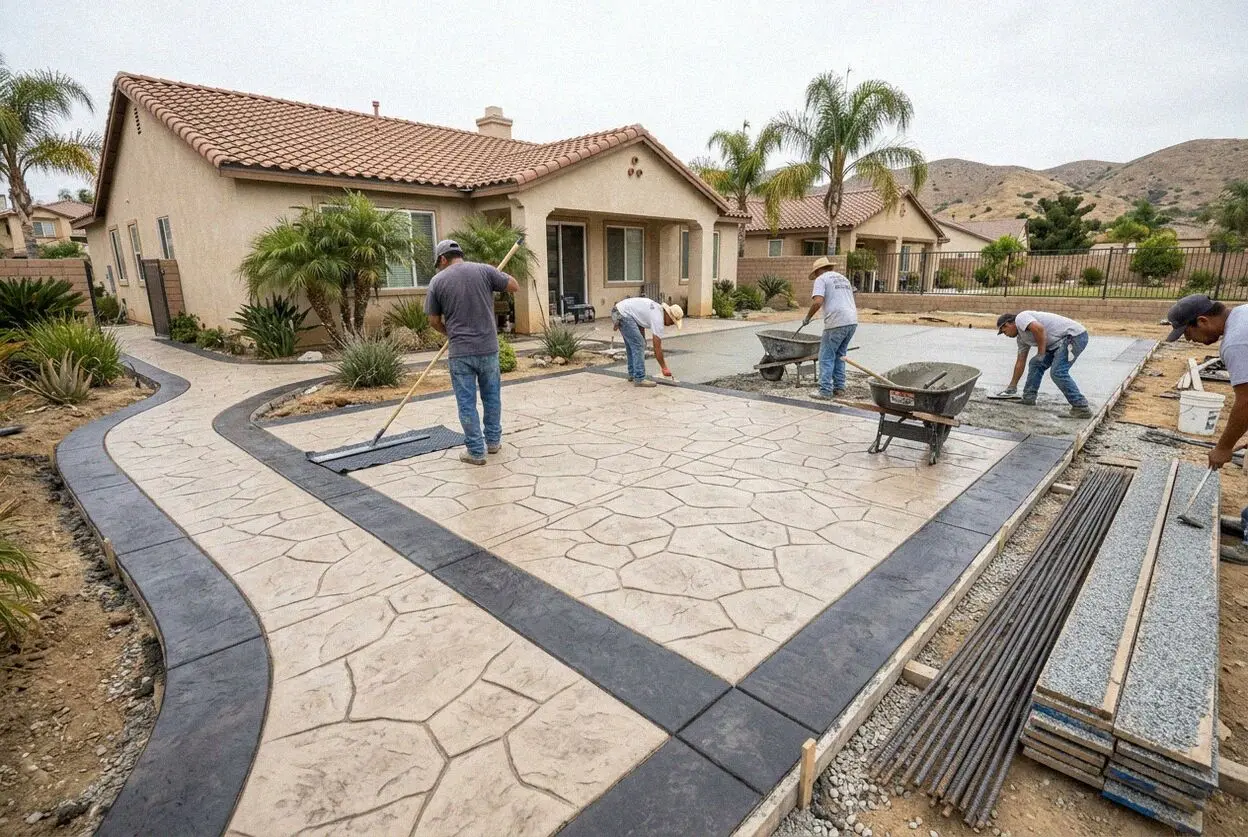
Crew pressing a slate pattern into a fresh slab at a Jurupa Valley home
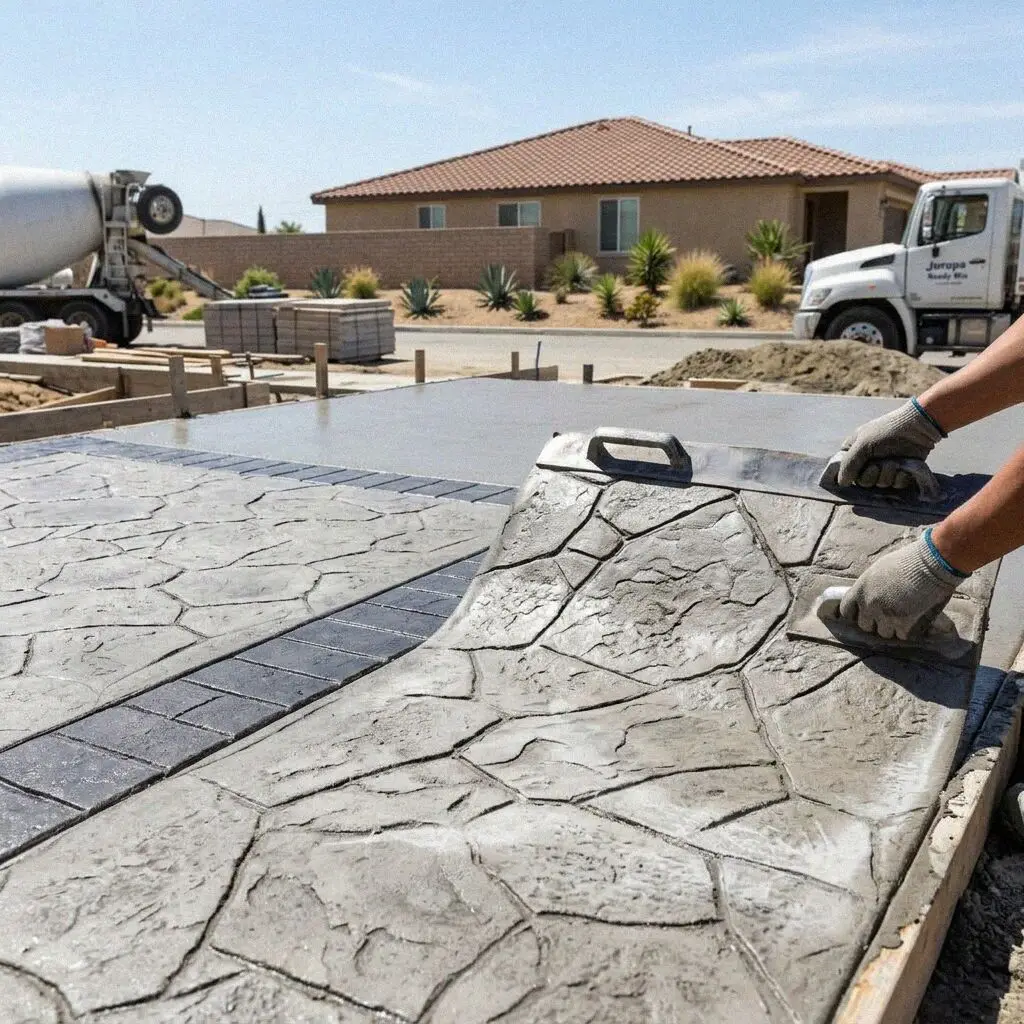
Hands working a pattern mat into wet concrete in Jurupa Valley

Scale first, then the mat

How We Stamp Concrete on a Jurupa Valley Lot

Stamped concrete is a pattern pressed into the slab while it is still plastic and a color carried in the load or broadcast onto the surface, and all of it is spent inside the hour the concrete stays open. The lots here give that hour a lot of ground to cover. A patio wrapping two sides of a house, or an entry court a car turns on, is one surface taken in from thirty or forty feet away rather than in the six-foot view a narrow frontage gives, and the pattern has to hold at that range.

SkyVale Jurupa Valley Concrete was founded in 2025 by Daniel Reyes, who spent 12 years on Inland Empire flatwork crews first, and he sets the mats out and marks the joint grid himself. Stamping is the one job on this list where the crew is sized to the square footage rather than to the calendar, because a large area has to be pressed end to end inside one window. A line where the mats stopped and started again is not a thing that seals out or wears away.

Patterned flatwork goes in under a CSLB C-8 concrete license with liability insurance on every job, on base dug and compacted to what a plain pour gets, since a stamp conceals nothing that settles beneath it. Color and curing follow the practice the American Cement Association publishes for colored slabs, which is where the 28-day wait before the first sealer coat comes from. Every finished slab carries a written workmanship guarantee against defects in how it was built.


When to redo it

What tells you a stamped slab in Jurupa Valley is done?

A stop line across it

A slab stamped in one window has no straight edge through the middle of it. Where the pattern goes shallow along a line and picks up past it, the mats met concrete that had already gone off and a fresh start was made. No sealer closes that line and no traffic wears it out.

Cuts across the stones

Every slab is cut for shrinkage, and on a stamped one those cuts belong down a grout line. A saw line taken through the face of a stone, or a grid paying no attention to the pattern, means the cutting was worked out after the mats came off instead of before they went on.

One area, two tones

A patio lighter at one end than the other, along a line rather than a gradient, is two truckloads dosed apart rather than sun. It shows as the sealer thins, so a slab even for two summers can come back divided. A tinted coat over it wears through and brings the split back.

The road edge broken

Many streets here finish at a shoulder rather than a curb, so the last feet of a stamped drive sit on ground that wheels work daily. Pattern cracked across that edge, or a section rocking under a tire, is the slab moving on what is beneath it. That repair starts below the surface.

On every stamped pour

Eight Things Standard on a Jurupa Valley Stamped Pour

Standard on stamped work, none of it added back as an extra afterwards. Most of it is here because the look of the slab is decided in the hour the concrete stays workable, and because a large area gives that hour more ground to cross.

Old surface broken out

The failing slab is broken out and hauled, a tired 1990s stamped patio included, since no new pattern goes down over ground that is already moving.

Ground opened and checked

The subgrade is opened and looked at before base goes in, because a crack that later crosses a stone cannot be patched without the repair showing.

Base as a plain slab gets

Class 2 base compacted in lifts to the depth an unpatterned pour gets, because a stamp hides nothing that settles or drains badly beneath it.

The joint grid drawn first

Control joints are laid out on the plan at 8 to 12 feet on a 4-inch slab before a mat is chosen, so the pattern is set out from that grid.

Pattern squared to it

Mats are run out dry over the forms from that grid, so the cuts fall on grout lines and no half stone finishes against the house wall or a step.

Color dosed in the load

Integral color goes in at the plant and is mixed through the truck, so a chipped edge in ten years shows the same tone rather than gray underneath.

Enough hands for the area

The crew is set by the square footage and the forecast, so the whole area is stamped inside one window and no stop line is left across the middle.

Sealed and handed over

Release washed off, two thin coats once it has cured, then the site swept and the sealer named in writing with the month the next one is due.

Choosing the pattern

Stamp Patterns for a Jurupa Valley Lot, Compared

Pattern is what the mats decide, and over a wide area it is a question of scale before it is a question of stone. These four differ in how large the unit is and what that costs in hand work. All take the same base, the same joint grid and the same color methods.

OptionStone sizeAt forty feetHides a saw cutHand tooling
Large ashlar slateStones up to 3 feet acrossHolds as one surfaceBest of the fourBorders and edges only
Seamless textureNo repeating unit at allEven, with no rhythmA cut reads as a score lineLight, no joints to retool
Running bond brickBrick at 8 by 4 inchesTurns busy across a driveCuts land on a bed lineEvery edge cut and tooled
Random flagstoneIrregular, 6 to 18 inchesLoses its shape at distanceA cut vanishes in a jointEvery joint retooled by hand

Stone size is what sets the hand work, and a large area multiplies it: a cobble over 800 square feet is a day of retooling the same area in ashlar never asks for.

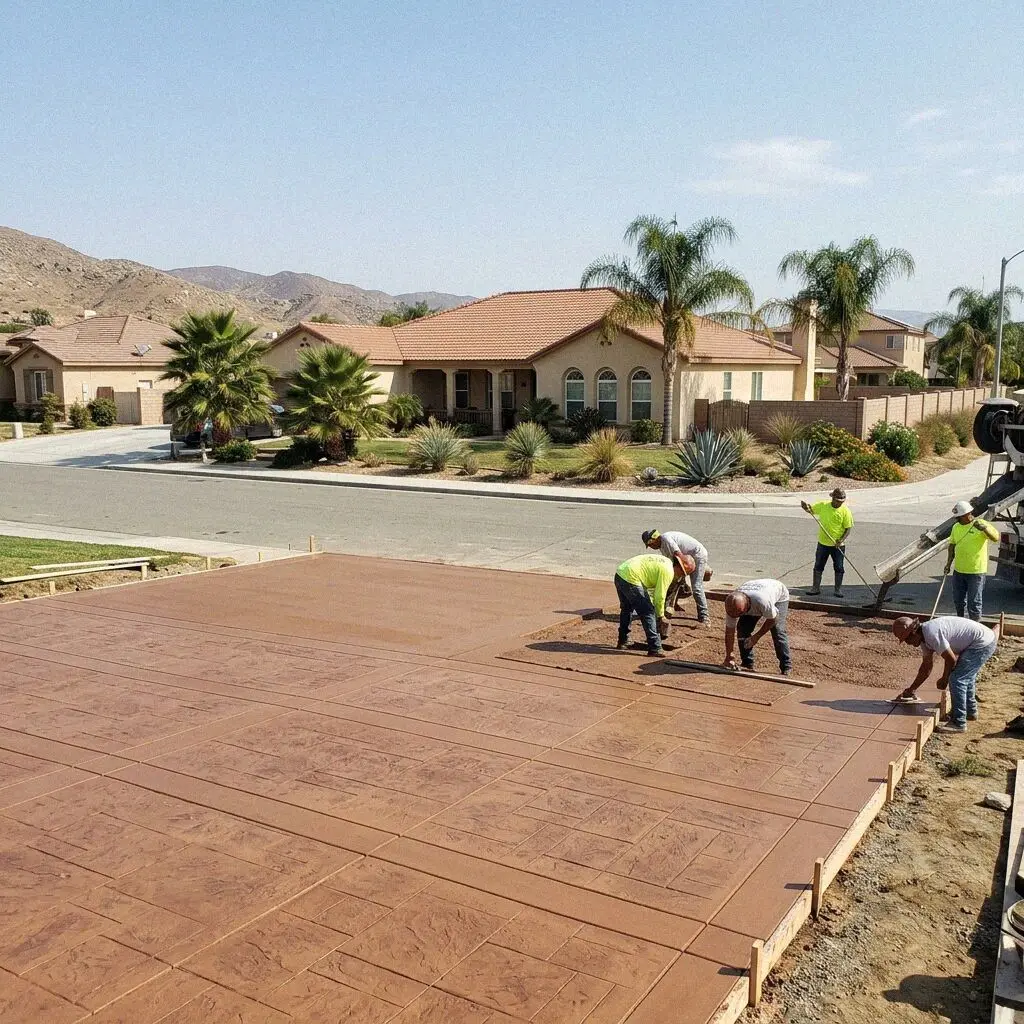
The crew finishing a stamped concrete slab at a Jurupa Valley home

Lot size and heat

Why Scale Decides a Stamped Slab in Jurupa Valley

The pattern question here is really a question about distance: how far back the slab is read from, and how few minutes an afternoon in the mid-90s leaves to press one in.

Flatwork on these lots runs wide. An entry court, a patio turning a corner of the house in Pedley, a pad big enough to stand a trailer beside in Glen Avon: each is seen whole, from one end, and a stone under a foot across breaks into noise at that range while a three-foot ashlar still reads as stone. The grid does the same. Control joints at 8 to 12 feet show as a grid whatever pattern sits on them, so it is drawn to the shape of the area first and the mats are registered to it.

Heat takes the other half. Jurupa Valley sits in the mid-90s in July and August, and concrete has to be stiff enough to hold a print and soft enough to take one, a window that shuts fast in that air. Summer work starts before 8 AM with the mats laid out, and if the forecast turns extreme the date moves rather than the print goes shallow. The same sun is what the sealer spends itself on, which is why stamped work here is resealed every 2 to 3 years and nearer 2 where no tree shades it.

How the job runs

How We Run a Stamped Pour in Jurupa Valley

Five stages, and the two that fix how the slab looks both finish before concrete is ordered. The man who measures the area is on the mats on the day, which over a wide pour is what keeps one end matching the other.

1

Walked, measured, sampled

Daniel Reyes measures the area, stands at the far end of it, and lays the mats and the color chips on the ground where the slab is going.

2

Grid, pattern and color signed

You pick the pattern and how the color goes in, and the joint grid is drawn on the plan. All three are written down before a truck is booked.

3

Tear-out, ground and base

The old surface comes out, the subgrade is opened and proved, and Class 2 base is compacted in lifts with the forms set square to the grid.

4

Pour, color and mats

The colored load is placed and floated, release goes down, and the mats are pressed in sequence with the hands to reach the far end in time.

5

Cut, wash and seal

Joints are sawn on the grid the day of the pour, the release washed off a day later, then two coats of sealer once the slab has cured.

What sets the number

What Moves the Figure on a Jurupa Valley Stamped Slab

Area starts the figure. What moves it after that is how much of the surface gets touched by hand once the mats lift, and that is decided by the pattern, by how deep the color goes and by the month.

How much is one surface

A single pad is one mat run. An area turning a corner has two directions to keep square, which is layout time before it is stamping time.

Stones to the square yard

Ashlar at 3 feet across is a handful of joints a yard. A flagstone at forty stones to it is forty joints to retool by hand once the mats come off.

How deep the color goes

Integral color is dosed at the plant and adds nothing to the day. A hardener is broadcast and worked in, a second pass across the whole area.

Hands on it before eight

A July pour starts at first light with extra finishers, so the far end still takes a print. The same slab in November is stamped by half the crew.

Nothing here is figured off a photograph. Every estimate is measured and written on site, and you hear back within 1 business day to fix a time. (951) 555-0159 or send us a message.

Ready to size up a stamped slab in Jurupa Valley?

Send the form or call the office on Limonite Avenue. The mats and the color chips come out to the property, and the pattern gets judged from the far end of the area in daylight rather than off a chart indoors.

Request a Free Estimate

Written on site · No obligation

By submitting, you agree to our disclosure and consent terms, including being contacted by SkyVale Jurupa Valley Concrete.

Stamped jobs here

Three Stamped Jobs in Jurupa Valley, in Their Words

Three reviews left by owners whose stamped work we poured: one entry court, one patio done in the middle of August, and one drive that had been laid in two mismatched pours.

Google review

“The turning area in front of our garage is wide and I was afraid it would end up looking like a paving catalogue. He put a large ashlar down and drew the saw cuts on the plan first, so from the gate it reads as one surface instead of a grid with a pattern on top.”

Elena M. of RubidouxStamped entry court · Google · 2026
Facebook review

“They poured 620 square feet behind the house in the first week of August. Six of them were here before six in the morning and it was all stamped before the heat came up. There is no line across it anywhere, which is more than the patio we had done at the old place.”

Curtis W. of PedleyStamped patio · Facebook · 2026
BBB review

“Our old drive had been done in two goes and the two halves never matched. This time the color went in at the plant and both loads came out the same. He also wrote the sealer down and the month the next coat is due, which no one had bothered to tell us before.”

Ximena X. of Mira LomaStamped driveway replacement · BBB · 2025

Questions

Stamped Concrete Questions from Jurupa Valley

Scale, heat, color and what the joints do, answered for a stamped slab on a lot in this city rather than for decorative concrete in general.

(951) 555-0159
  • What makes one stamped patio cost more than another?

    The hand work after the mats lift, not the stamping itself. A large ashlar over a square area in one integral color is close to a plain pour for labor; a flagstone with a contrasting border and edges following a planting bed is an extra day of retooling on the same square footage. The month counts too, since a July slab takes a bigger crew. Every estimate is measured and written on site.

  • How long before we can use a stamped patio?

    Off it for 24 to 48 hours, cars back on a stamped drive at 7 days, and full strength at 28. The sealer is what makes a stamped slab a longer job than a plain one: the release is washed off the day after the pour, then the surface has to cure a full 28 days before the first two coats go on, because color is still moving until then. You get the date for that visit at the walk-through.

  • How large an area can you stamp in one pour?

    As much as the crew can press before the concrete sets, which is the real limit rather than the size of the truck. That is why the hands are booked against the square footage and the forecast instead of a standard crew turning up. Where an area is genuinely too big for one window, it is split at a border or a step that was already going to be there, so the break is a designed line and not a stop line.

  • How often does stamped work need resealing out here?

    Every 2 to 3 years, and nearer 2 on anything standing in the open. Sealer is what carries the color and the sheen, and ultraviolet is what takes it off, so a patio with nothing shading it gives up a coat faster than one under a cover. On a wide area that is a full day of washing and coating, which is worth knowing before you decide how much ground the pattern covers. We hand over the product name and the month.

  • Integral color or a color hardener on a wide slab?

    Integral for anything in open sun, a hardener where something shades it. Integral is dosed into the truck so the color runs through all 4 inches and a chip shows the same tone. A hardener sits about an eighth of an inch down and gives a denser, richer face, which earns its place on a covered patio and not on a turning area where tires scrub the same few feet every day.

  • Will the control joints show through the pattern?

    They will show, and the aim is that they read as part of it. Concrete shrinks and it cracks somewhere, so a cut every 8 to 12 feet on a 4-inch slab decides where. Run that cut down a grout line and it disappears into the pattern; take it across the face of a stone and it is a line for the life of the slab. That is the whole reason the grid is drawn before the mat is chosen rather than after.

  • What does the guarantee cover on a stamped slab?

    How it was built, which on this job includes the pattern as well as the concrete: the depth of the impression, the joints landing where the plan put them, and a surface stamped end to end with no seam through it. The terms are on the estimate you sign. Color that has faded on the normal cycle, and a slab left unsealed years past its due month, are wear rather than defects and sit outside it.

  • Can you match a stamped patio that is already down?

    Sometimes closely, rarely exactly, and it depends on what is written down. If the pattern is one still in production and the color was recorded, a new area next to it can be brought within a shade or two once both are sealed together. With nothing on paper we make sample boards on site and pick from them outdoors. The honest answer is often to run a border between the old and the new instead.

Where we stamp

Where We Stamp Around Jurupa Valley

The eight nearest towns on the list, with the straight-line distance from the yard on Limonite Avenue beside each. The mats and the color chips travel to every one of them.

Show All Areas We Serve

See the pattern on your own Jurupa Valley lot

Two minutes on the form books the visit. Tell us roughly how much ground the slab has to cover and whether anything stamped is coming out first, and the rest gets settled standing on it.